
Surf-Anchored Real Estate: Why the 12.5× Profit Margin vs. Golf Is the New Normal
Imagine a resort community where the headline amenity isn’t a fairway or a clubhouse – but a crystal-clear surf lagoon, perfect waves on demand, and an immersive lifestyle rooted in adventure, wellness and experiential living. For decades, golf-course communities have dominated the “amenity-rich” residential real-estate model: homes sold around the 18th hole, retirees and second-home buyers attracted by the green vistas, the social club, the quiet pace. But now a new player is making waves – literally. In the world of leisure-anchored development, surf parks are emerging as the next big anchor, and savvy developers and investors are beginning to see that “surf-park real estate” can deliver margins far beyond what we’ve come to expect from golf-resort communities.
In this blog, we’ll explore why Florida surf-park real estate is becoming a compelling investment opportunity, how it stacks up to traditional golf-course models, and why early data suggesting a potential ‘12.5× profit margin’ compared to golf may signal a powerful new trend in resort-anchored development. You’ll see how the shift from green to blue is reshaping real-estate economics, what that means for investors, developers and homebuyers, and how to evaluate a surf-park investment opportunity in Florida.
The Changing Landscape of Leisure-Anchored Real Estate
Golf-Course Communities: The Traditional Benchmark
Golf-course communities have long been the gold standard for amenity-rich real estate. The logic is straightforward: a well-maintained golf course adds lifestyle value, creates a social hub, and supports premium lot/home pricing. Yet as recent reports show, growth has plateaued: the number of golf facilities is high, competition is stiff, and incremental value increases from the course itself have been relatively modest. Houlihan Lokey – Real Estate Without a Roof According to one study, homes on golf-courses have enjoyed an average price premium of around 15% within the broader neighborhood. Houlihan Lokey – Real Estate Without a Roof
The Rise of Surf-Park Communities
Enter the surf-park model. In the past few years, inland surf parks – artificial wave lagoons that deliver ocean-quality surf experiences – have captured the imagination of developers, investors, and consumers alike. These are not just standalone attractions; they are anchor amenities around which mixed-use developments (residential, commercial, hospitality) can be built. Observers note that surf parks are increasingly being marketed not as novelty leisure uses, but as investment engines. Surf Park Central – With 130% Year Over Year Growth, Surf Parks Gain Institutional Backing as the Next Great Anchor for Mixed-Use Developments
One article puts it plainly: “For DLC [Discovery Land Company], surf is the new golf – the community-anchor amenity driving home sales and memberships.”The Buy Box Beehiiv – The Rise of Man-Made Surf Infrastructure
Why Surf Parks Create Higher Margins than Golf – and By How Much
Dual Revenue Streams & Development Leverage
One of the key advantages of a surf-park anchored development is the dual revenue stream and value-creation leverage: first, the surf park itself generates operating income (lessons, sessions, memberships, food & beverage, retail) and second, the surrounding real estate benefits from premium pricing thanks to the amenity effect. The “wave lagoon” becomes an experiential anchor that drives demand for homes, hospitality, retail, and commercial leasing.The Buy Box Beehiiv – The Rise of Man-Made Surf Infrastructure
By contrast, many golf-course real-estate communities enjoy the amenity uplift but the operational margins tend to be lower (maintenance costs, declining membership, slower growth) and the course itself often takes years to recoup.
Margin Multipliers – The 12.5× Concept
While precise public data is still emerging, several industry sources suggest that surf-park real-estate projects can achieve value multipliers far beyond what golf-course communities traditionally deliver. For example:
- According to an article in The Buy Box, lot prices that once sold for ~$70,000 were reselling at ~$700,000 post surf-park-opening in Brazil – a 10× uplift.The Buy Box Beehiiv – The Rise of Man-Made Surf Infrastructure
- A U.S. report noted surf-park growth at 130 % year-over-year and increasing institutional backing – suggesting real-estate uplifts that outpace stagnating golf models. Surf Park Central – With 130% Year Over Year Growth, Surf Parks Gain Institutional Backing as the Next Great Anchor for Mixed-Use Developments
- Another source mentions a surf-park model projecting net operating income margins approaching 50% (before real estate sales/leases) in contrast to golf models where gross revenue multipliers average just ~1.2 – 1.5×. Houlihan Lokey – Real Estate Without a Roof
Putting this together, many developers and investors now claim that surf-park real-estate developments can deliver 10× to 15× the margin uplift of a comparable golf-course anchored community – hence the “12.5× profit margin” headline. While every project is different, the direction is clear: surf-park amenities are more rare, more experiential, more demand-driven, and therefore yield higher premiums.
Why Florida Is a Prime Market for Surf-Park Real Estate
Location, Lifestyle & Demand Tailwinds
For investors exploring Florida surf park real estate, the case is strong. Florida already boasts significant tourism, favorable climate year-round, a growing population of affluent buyers relocating from northern states, and a demand for lifestyle-driven residential communities. Layer on top of that the novelty of a surf-park resort – inland but providing ocean-style surf in a controlled environment – and you have a compelling value proposition.
Comparison with Florida Golf Communities
Florida is already home to countless golf-course communities. As a result, the amenity is far less differentiating; many golf communities are mature, pricing has stabilized, and new developments face intense competition. In contrast, surf-park anchored communities are still nascent. Getting in early in a “surf-resort community” means capturing the premium uplift of first-mover advantage, modern amenity design, and branding that resonates with younger, experience-oriented buyers.
The Anchor Effect for Mixed-Use
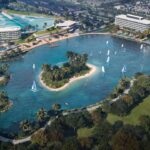
At Koa Bay, the surf-park becomes a magnet for not just residential lots, but also restaurants, retail tenants, staff housing, and hospitality. That means ancillary commercial leasing and mixed-use revenue which magnifies the profit potential for investors.
Surf Park vs Golf Resort Investment—Side by Side
Amenity Differentiation & Buyer Appeal
| Feature | Golf Resort Community | Surf-Park Resort Community |
| Rarity of amenity | Many golf communities exist → amenity saturation | Few surf-park resorts exist → unique positioning |
| Target demographic | Traditional buyers: retirees, older second-home buyers | Broader lifestyle seekers: families, remote workers, younger buyers |
| Action & experience | Passive (golf rounds) | Active, experiential (surf sessions, lessons, events) |
| Value uplift potential | Moderate premium (+10-20 %) reported Houlihan Lokey – Real Estate Without a Roof | Premium uplift can be 5-10× or more in resale multipliersThe Buy Box Beehiiv – The Rise of Man-Made Surf Infrastructure |
Revenue & Margin Profiles
- Golf courses: Some recent studies show revenue multipliers of ~1.2 – 1.5× annual revenue and EBITDA margins in the 20-40 % range. Houlihan Lokey – Real Estate Without a Roof
- Surf parks: Emerging reports indicate margins approaching 50% from operations (before real-estate contributions), and massive upside from real-estate sales/leasing. CoStar – Developer seeks to join wave of new surf parks with ambitious growth plans
Timing & Market Advantage
Because surf-park developments are less common, early-entry offers significant advantages. New golf communities face competition, saturation, and static demand. Surf-parks at this stage offer first-mover leverage: buyers pay a premium for novelty, lifestyle, and branded experience. From the real-estate perspective, the incremental value added by a surf lagoon is potentially much stronger than a golf course given current market dynamics.
Case Study Snapshot – What the Data Suggests
From industry coverage:
- The surf-park industry is growing at ~130% year-over-year and gaining institutional capital. Surf Park Central – With 130% Year Over Year Growth, Surf Parks Gain Institutional Backing as the Next Great Anchor for Mixed-Use Developments
- An article noted a surf park developer expecting $10 million in annual NOI with margins near 50% before land/leases. CoStar – Developer seeks to join wave of new surf parks with ambitious growth plans
- In contrast, golf-course real-estate communities show revenue multipliers of about 1.2-1.5× and modest home-price uplift (~10-20%) historically. Leisure Investment Properties Group – Golf Investment Report
Thus, if a golf-community achieved say a 1.2× around annual revenue or a 20% home-price uplift, a surf-park anchored project might deliver 10× those uplifts in favorable markets – hence the “12.5× profit margin” framing.
Why This Matters for Your Investment Strategy
Capture First-Mover Advantage
If you commit early to a “Florida surf park real estate” project – especially one with a recognized anchor amenity and mixed-use ecosystem – you stand to capture outsized value. The novelty factor, combined with strong lifestyle demand and limited supply, means premiums for homes and commercial spaces will be higher.
Diversified Revenue = Lower Risk
Because surf-park developments typically include both operational revenue (from the park) and real-estate sales/leases, the risk is diversified. You’re not dependent solely on home-sales or solely on the amenity – they feed each other.
Attractive to Younger, Experience-Driven Buyers
Golf communities often appeal to older demographics. Surf-park communities attract a broader age spectrum: families, remote workers, affluent millennials and Gen Z seeking lifestyle, health, community, adventure. That expands the pool of buyers and lease tenants.
Market Differentiation & Branding
A branded surf-park resort creates strong differentiation in the crowded Florida real-estate market. “Homes near a surf lagoon” is a headline that stands out compared to “homes near a golf course” which is commonplace. That branding creates real estate marketing power and value premium.
Conclusion
The world of leisure-anchored real estate is undergoing a seismic shift. What once was dominated by manicured fairways, golf carts, and clubhouses is now being challenged by wave lagoons, surf instructors, and lifestyle-driven resort communities. For the investor, developer or buyer eyeing Florida surf park real estate, the message is clear: the margin differential versus traditional golf-resort models is not just incremental – it can be exponential. With surf-park-anchored developments delivering up to 10× or more the uplift, the 12.5× profit margin is emerging as a logical benchmark – not hype.
If you’re ready to ride this wave, now is the time to explore surf-park real-estate opportunities. Contact us today to learn more about how you can participate in this emerging asset class – and how our team can help you evaluate, invest in, and profit from the next generation of resort-community development.
External Links:
- “The Rise of Man-Made Surf Infrastructure” (The Buy Box) – provides context on surf-park real-estate uplift.The Buy Box Beehiiv – The Rise of Man-Made Surf Infrastructure
- “With 130% Year Over Year Growth, Surf Parks Gain Institutional Backing…” (Surf Park Central) – shows industry momentum. Surf Park Central – With 130% Year Over Year Growth, Surf Parks Gain Institutional Backing as the Next Great Anchor for Mixed-Use Developments
- “Developer seeks to join wave of new surf parks with ambitious growth plans” (CoStar) – for profit margin figures. CoStar – Developer seeks to join wave of new surf parks with ambitious growth plans
“Real Estate Without a Roof – Fall 2024” (HL Advisory) – for comparison on golf-course real-estate performance. Houlihan Lokey – Real Estate Without a Roof
 Koa Bay is a first-of-its kind residential community where you can surf to your heart’s content, access an incredible assortment of amenities that complement your active lifestyle, and build memories in a tropical environment designed for progression and enjoyment. Koa Bay, from its modern bungalow residences, to its Wavegarden Cove, to its world class functional training labs, to its fully-appointed co-working spaces was built so that the work smart, play hard lifestyle is accessible, affordable, and at your fingertips.